
The global labour implications of the Minnesota Economic Blackout
The Minnesota Economic Blackout points to a future for mass worker action.

Whatever happens throughout Friday January 23rd in Minnesota it is an historic day, and it will have far reaching implications for the future of organised labour.
A strike by any other name hits just as hard
Whether you call it a general strike or an economic blackout, for me this is a matter for the people taking the risks on the ground, it looks like Minnesota is set to shut down in a matter of hours with its Day of Truth & Freedom.
I hope the action is solid and awesome. The growing coalition of supporting unions, faith groups, and community groups is impressive. Whatever happens though it is historic. It is not a general strike as historically understood, it is something new (at this scale) with the potential to be just as transformative.
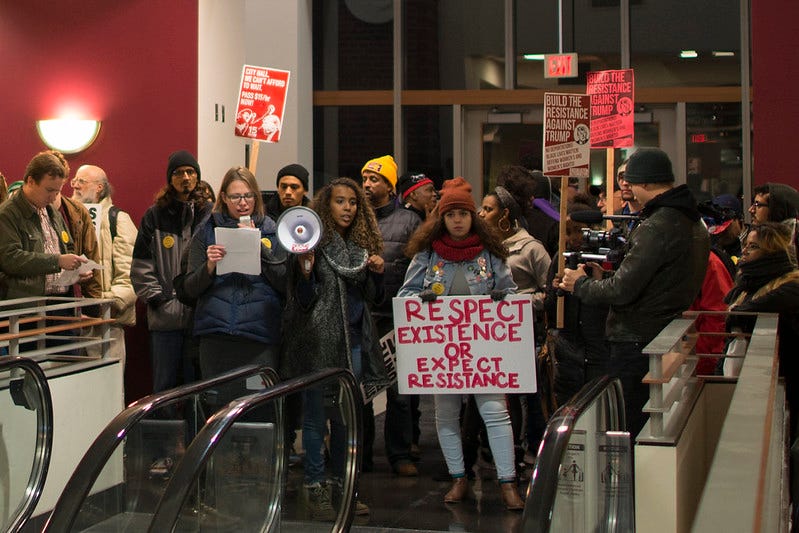
The economic blackout is a species of disaster organising where the fight is to protect the very right of workers to exist safely within a given community. As the sign says in the above picture, it is a call to “respect existence”.1 Disaster organising has appeared in the Anglophone world over the last decade through climate disasters, the COVID-19 pandemic and now in response to a political situation that amounts to a forcible occupation.2 What makes Minnesota new is that the disaster is political. It takes the form of the naked force of the federal US state being unleashed on residents and workers.
Disaster organising
Much good work has already been written about disaster capitalism (how capitalists use moments of crisis and disaster to entrench their control).3 But such moments are hinge points for they can also reveal the underlying truth behind social relations that we otherwise take for granted. Ryan Ward’s article on capitalist crisis and memory powerfully illustrates this point. Disaster organising describes the work to resolve such moments such that they build worker power. It is the counter-movement to disaster capitalism.
Disaster organising ensures basic worker and social safety in the midst of a breakdown in a community’s lived experience of capitalism. This is where we can draw the throughline been the ICE operation in Minnesota and the ongoing climate breakdown.
The social norm is no longer a state of non-disaster but rather the experience of shifting between disasters with the time in between merely a state of pre-disaster, post-disaster, or some combination of the two. Disaster organising becomes a way of building worker power within and between disasters. It is a myth of the current social order that in the face of an immediate or crushing disaster, the human condition is limited to the fight, flight or freeze responses. The idea that in such circumstances humans respond only with their lizard brains is nothing but the nonsense of common sense.
Humans are not angry lizards only kept in check by the genius of the market or the authority of a sovereign. We are social creatures. Humanity’s evolutionary advantage is cooperation and worker-to-worker cooperation is an expression of our humanity. Human rationality is relational – a way of working things out beyond brute force or physical displays. As social creatures, we have an additional stress response – one that draws on our advantage as a species – to tend and befriend.
In response to disaster, people do not simply degenerate into a mindless violent horde but rather attempt to find ways to help each other, to cooperate and engage in mutual solidarity.
Yeah but how does it actually work to build power?
Stopping work, and supporting each other to do so, is central to disaster organising. Like a strike, it is a withdrawal of labour but it does not necessarily need to have a specific claim over and above workers putting pressure on the employer class to better ensure their safety. Its overriding claim is the right to existence, the right to live and work safely. It forces employers to adopt a whole range of mitigation measures depending on the context .
What disaster organising does is to force business to internalise some of the costs of a disaster. This can force a government to better look after the needs of its residents without falling foul of market discipline. If capital has to pay workers to take breaks during a heatwave, the climate crisis ends up on its balance sheet. If businesses have to accept that its workers cannot safely make it to work due to ICE raids it has to take on some of the direct costs of reaction. Disaster organising is the intervention of worker power to push the costs of its own disasters back onto capital.
It has a legal basis
Rooted as it is the bodily integrity of workers, disaster organising has a legal basis. It can be a way to forcibly roll back the highly curtailed right to strike. Workers around the Anglophone world have the right to cease work where there is an immediate threat to their health and safety. In the US, this generally occurs at a state-level (including Minnesota).4
To understand the difference between a cease work for safety purposes and a strike, think of a fire in an office building. When a fire alarm has gone off in an office building, workers have the right to cease their work (even if a team leader gives a direction to wait momentarily and complete a work task), and follow the evacuation plan to rally at the designated evacuation point.
In a stable environment, this right to cease work can be easily overlooked as a matter of strategic relevance for workers outside industries at higher risk of workplace fatalities. In a context of social and climate breakdown, however, this basic right – one of the fundamental markers that differentiates employment from slavery – becomes the difference between life and death. It is the difference between a worker in Minnesota getting thrown into the new US gulag network or going about their daily grind.
All power to the workers of Minnesota, your fight is our fight.
Yeah I know the actual image is from 2016. Kinda makes it more interesting.
It is important to note that I’m very much not claiming that disaster organising originated in the Anglophone world. It is an emergent condition within the Anglophone world as the multi-faceted capitalist crisis has deepened through the 21st century. It has many global precedents.
See Naomi Klein, The Shock Doctrine (2007) and Antony Loewenstein, Disaster Capitalism: Making a Killing Out of Catastrophe (2015) in particular.
This potentially introduces a direct shopfloor thread to Christopher Armitage’s work on federalist resistance. Also, if you want to know your safety rights specifically talk to your relevant union or union federation (please don’t take my general word for it).
Nice piece. I’ve been thinking a lot about how the labour organisation in preparation for a strike is not only crucial to its success but the infrastructure that is put in place then provides an alternative distribution and mutual care network that can be utilised in the future in other times of crisis. This piece captures those thoughts and articulates them well for me.
We should help by putting pressure on companies like Target in Australia.