
On Collective Bargaining
Chapter Three: Solidarity Bargaining. Part II: the strengths and limitations of collective bargaining.

A critical engagement with collective bargaining requires closer examination of its relative strengths and limitations.
What is collective bargaining?
The socialist writer and activist, Beatrice Webb, first used the term collective bargaining in 1891. For Webb it described a process of workers collectively negotiating their wages and conditions with their employer in the form of a legally enforceable contract for a fixed period of time.
This process of collective worker involvement is mediated through an elected team of union bargaining representatives. The process of collective bargaining itself is such a key plank of union activity that for many, unions as an institution are synonymous with collective bargaining. This association between the two speaks to both how effective collective bargaining can be as a process, and how its limitations became the labour movement’s limitations.
The strengths of collective bargaining
There’s no doubt collective bargaining, as a means for realising wins from the collective power of workers, has resulted in historic gains for workers since the late 19th century. From the 8-hour day, the creation of paid leave through to sustained wage gains, all have emerged through workers taking action as part of various forms of collective bargaining around the world.
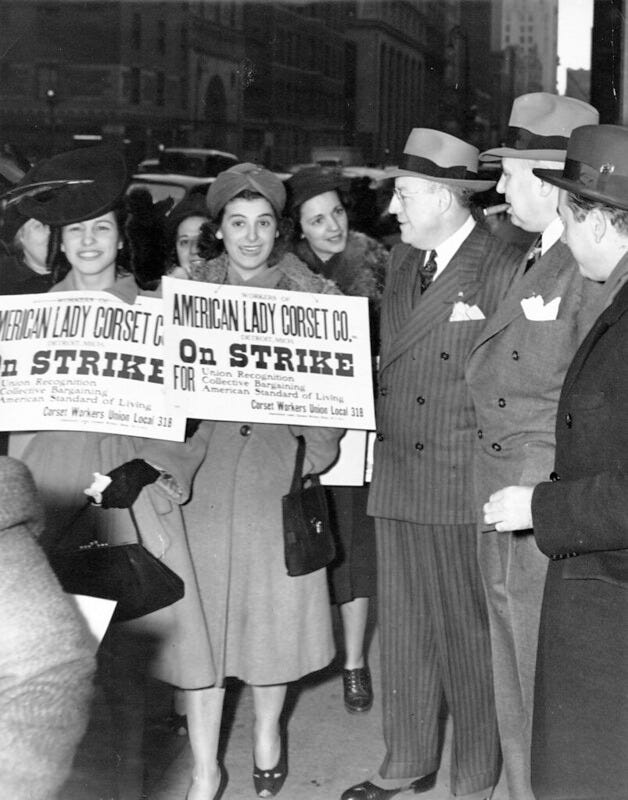
Even Australia and Aotearoa New Zealand’s unique system of conciliation and arbitration that persisted for much of the 20th century can be read as a form of heavily state-mediated collective bargaining. The remaining privileged sections of the working class in the Anglophone world largely maintained this relative position through collective bargaining.
In addition to its record as a means to achieve life-changing wins for workers, the other powerful aspect of the process of collective bargaining is that it locates the fundamental values and relations of unionism firmly within the lived experience of workers. It is a process, when done properly, where workers get to articulate how they are specifically experiencing the alienation and exploitation inherent to the wage relation, work through immediate claims to redress this experience, struggle for such claims and surprisingly often win material change based on these claims.
Through this process of claim-formation workers also find out what they have in common with other workers rather than bearing their exploitation alone. Collective bargaining, therefore, should be thought of as an effective means through which workers can exercise their power to ameliorate such exploitation and make a material difference to their own lives.1
Even in the social context of late-stage capitalism there are enough sites of opportunity to engage in collective bargaining as part of broader union strategy. These sites sit across at least one of two vectors – they are sites of essential social reproduction whose disruption has the real capacity to force a greater investment of resources or they are sites of ongoing capital investment where workers have the capacity to force a more equal distribution of the revenue from said investment.
Health, education, logistics, resource extraction, and the food supply-chains are examples of sectors of the economy that exist across both vectors even in a hollowed out neoliberal regime. Separate from strategic considerations of where best to engage in collective bargaining, the depth, width and potential accessibility of worker-to-worker cooperation intrinsic to the process makes it an effective vehicle for the building and maintenance of worker power.2
The limitations of collective bargaining
For all its demonstrated effectiveness, collective bargaining has historically had many trenchant radical unionists critique its limitations.3 Moreover, the record of union decline in the neoliberal era gives legitimacy to the critique even as the relative retreat of effective collective bargaining makes its absence felt in reduced working class solidarity and prosperity.
The crisis of working class organisation and living standards from 1980 onwards in the developed world is simultaneously marked by both the limitations of collective bargaining and its relative retreat from workers’ lives. Collective bargaining’s limitations opened the door for the elite’s neoliberal reaction, and its retreat made the reaction profitable for the same elites.
The radical critique of collective bargaining is that as a process it operates within the limits of the capitalist system and managerial control over the workplace. This is the alternative to collective bargaining’s very practicality – even as the process is grounded in the lived experience of workers within the system, it is a mechanism to cope within capitalism, and is thus necessarily limited in its horizons. This plays out in three tendencies.
First, it encourages workers to focus on a fair day’s pay for a fair day’s work as opposed to how they can own their own workplaces, jobs and lives. Even, therefore, as workers become disgruntled enough to organise and take action their focus remains, generally not always, restricted to making the wage relation work better for them as opposed to moving beyond the relation itself. Limiting the horizons of workers as subjects of history in turn limits possibilities for the future.
Second, it leaves capital in control of the workplace and the broader economy. This control undermines the foundations of worker power, and because worker-to-worker power waxes and wanes, it leaves organised labour forever open to capital’s reaction to force a new, meaner social settlement.
Worker power under capitalism is necessarily ephemeral in the sense that outside of an active industrial struggle it is objectively hard to ascertain beyond the reading of economic data which both informs and constructs social reality. A worker rebellion becomes clear only in hindsight even to those who have spent decades organising, and the same can be said of a reaction back to increased control by capital.
This is because worker-to-worker relationships are decentralised, and even objective data such as trade union membership or days lost to industrial action do not directly speak to the underlying strength or strain on these relations at any one point in time. Trust in workers, therefore, is an article of faith. Many who become agents of capital do so not just for their own personal material gain but also because they have lost faith in the collective emancipatory power of workers.
Collective bargaining, in summary, leaves authority in capital’s hands even as it asserts worker power. Such authority, due to capital’s continued drive to profit, will be used against workers where it is either forced to in order to maintain the flow of profits or it senses an opportunity to increase the volume of its overall profit take.
Third, in so far as collective bargaining delivers on its promise of improving workers’ lives, it can work to strengthen the capitalist system. It can act as a stabilising reaction for the daily horrors of the wage labour relation and as such give a layer of organised workers something to lose through system change.
Collective bargaining does this through opening a link to a socialist future and allowing capital in the present to feed off this energy to strengthen its own regime. It is a means to harness the power of worker struggle. Whether collective bargaining, however, is in capital’s interest is a contingent matter. At an enterprise or at a social level there are instances when the cost and/or confidence of labour is a threat to the extraction of profit, and at other times labour’s weakness, discontent or even malaise is itself the threat to the ongoing reproduction of the system.
It is, therefore, not so much that any instance of a struggle around wages and conditions of employment taking place within a collective bargaining framework is itself in capital’s interest but rather the very ability of having recourse to the process of collective bargaining is in capital’s interest. A tool, however, can both construct and deconstruct. The three tendencies are not iron laws and union workers have often used collective bargaining in a critical manner to work against such tendencies.
Drawing a productive synthesis from collective bargaining’s strengths and limitations
From this clash of reasoning with respect to collective bargaining, it is possible to draw a strategically useful synthesis. Both the case for and the critique of collective bargaining are valid insofar as the insights they draw.
Collective bargaining can be a powerful process that workers use to improve their living standards within the system but by taking the system as a given it can act to reinforce the system. What is required is a process of cooperation within collective bargaining regimes that can operate within, yet take workers beyond, capitalist rule.
This can be achieved both within the process of collective bargaining, and by clearly recognising the limits of the process. There is a reason why I have presented the overall solidarity strategy as a wedge – building a prefigurative space of worker ownership alongside a radical democratic politics works to complement the inherent limitations to collective bargaining. Part of the answer, however, lies in reimagining and reconstituting collective bargaining as an educative process that builds the working class as a conscious and deliberate social actor: a process, in other words, that creates a new working class subjectivity.
Solidarity bargaining is my attempt at such a reimagined form of collective bargaining.
This post is located within the third chapter within the second of three parts for the overall project. Part Two is Solidarity within Wage Labour and outlines a strategy to nurture solidarity between workers within the wage labour relation as it currently exists. Use the about page to locate where you are in this broader project.
Much of the late Jane McAlevey’s work from Raising Expectation (and Raising Hell) to Rules to Win By contain powerful accounts of effective and strategic collective bargaining campaigns that change workers’ lives.
Such work is vital. It not only complements solidarity bargaining but is likely a necessary precondition for its success. The universal can only ever find concrete form in the particular.
See for example the trenchant early 20th century opposition of the Industrial Workers of the World (IWW) to collective bargaining, especially in a craft union context, as a form of class compromise.
Your point re collective bargaining that ‘a tool … can both construct and deconstruct’ is an interesting counterpoint to Audre Lorde’s line that 'the master's tool will never dismantle the master's house’. I always thought Lorde missed the point that tools are also made by workers. They don’t have an eternal condition of being ‘owned’ by employers just because the master class benefits from them at any given time.
Have you thought about turning this series into a book after you're done writing it? I think it would be a useful thing to have.