
Disaster Organising
Part III: Building worker power up to combat climate breakdown

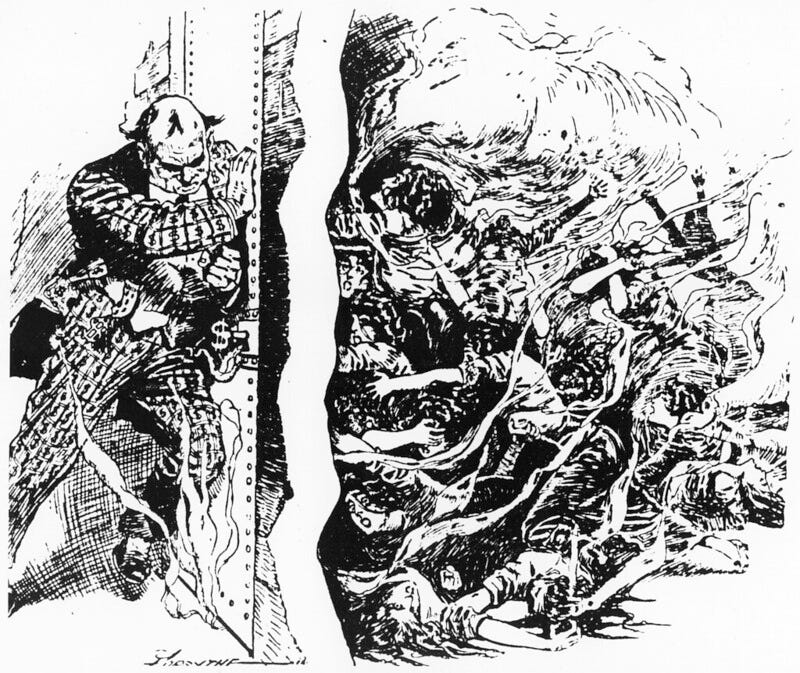
Workplace safety rights on the statute books are one thing but how workplaces operate is another matter all together. The functioning of ongoing wealth extraction relies on this gap. Other than trusting in the nobility and generosity of your workplace’s monarch (wielding their authority by the divine right of the dark gods of capital), how can a safe workplace be realised in the midst of climate disaster? The answer, of course, is found in worker to worker relations.
In most Anglophone jurisdictions, safety rights represent one of the most significant universal carve outs of managerial prerogative. It is a realistic pathway for autonomous worker structures available to all with sufficient commitment and dedication to workplace organising. If you’re in the United States, for instance, check out the Emergency Workplace Organizing Committee’s work.
Some unionists can conflate these instances of statutory authority as either power itself or a way to bypass the need for social cooperation between workers. There are parallels here with those who make the mistake of assuming there is a parliamentary road to socialism in so far as both are attempts to use state authority as a means through which to short-cut or bypass the need for the hard graft of building relations of social cooperation between workers. There can be no escaping the necessity for socialism to first be socialised.
Disaster Organising
Disaster organising is a way of using safety rights to organise worker power at scale based on workers’ actual and lived experience of climate breakdown. There are a number of phases to this work. The first is raising expectations that climate disasters and other forms of extreme weather are an issue that employers have to exercise responsibility over even as they are not capable on an individual basis of eliminating the hazard. This is no mean feat as outside of spectacular disasters, suffering from extreme temperatures is often an atomised and hidden experience. In the northern hemisphere summer of 2022, it was estimated that 62,000 Europeans died from that summer’s heatwave.1 At the time, this barely registered in the public discourse (broken as it is).
This atomised suffering tracks with the experience of Australian workers where the Heat at Work report found over 60% of United Workers’ Union members had suffered severe impacts from extreme heat, including but not limited to nausea, zoning out, headaches and vomiting. Workers internalise this suffering, in part, because they do not view their employer as having any responsibility to act on this issue.
This work of expectation raising, one that combines both the experience of an extreme climate with education on the employer’s responsibility, could take many forms; union meetings, material supporting direct conversations in the workplace, essay writing or short videos, refresher courses for HSRs to name but a few options. The guiding principle here is to encourage the growth of social cooperation between workers through helping workers connect their atomised suffering as part of a broader class experience of living through climate breakdown.
Connection is key. As capital dissolves social bonds it not only creates atomised workers but it works to atomise suffering itself. When suffering is experienced alone there remains a surface of social normalcy disconnected from the lived experience of actual people. A connection across any vector of suffering could, therefore, result in other, new connections forming.
Worker education and action
Of course, education without an outlet for action is itself its own kind of suffering. Creating the infrastructure for action is vital. One component piece to this end is a basic introductory seminar with respect to OSH rights, climate disasters and extreme weather.
The education team at the United Workers’ Union has already done this – it goes for 90-minutes, is capable of being delivered online or in-person, and the training notes are available to other unions as well as other progressive civil society organisations. The Union trained over 1000 workers with the first two years of rolling it out in 2020. The seminar is more than just a session designed to assist workers in understanding their applicable safety rights, it encourages workers to think about their current context at work, and to plan out actions using their existing rights to better protect themselves and their coworkers from extreme temperatures and climate disasters at work.
Aside from the focus on rights and action, the other focus of the seminar is on workers sharing their experiences as a way of overcoming the atomisation of suffering. A feature of this seminar is its relative scalability. That is for a relatively low-cost, and the ease with which trainers can be trained to deliver the seminar, tens of thousands to hundreds of thousands of workers could attend and participate in the seminar as it can be delivered by a range of different unions and civil society organisations.
Such a program could be extended into a similarly straightforward hybrid online/in-person seminar on electing safety reps. One of the streams through which workers could enrol into this training session is as a follow up from the climate disaster/extreme temperature seminar. As the climate disaster seminar casts a wide net, workers who are either leaders or activists can then follow up with this training session. The course would be another informal 60 to 90 minute session that is relatively accessible for workers to attend on their own time, and it would too be action-focused with a concentration on the process of successfully electing and training safety reps.
Such a focus would provide interested workers the time and space to understand the obstacles and roadblocks employers throw up to attempt to prevent genuinely independent worker-elected representatives. The inclusion of this form of inoculation from suspected employer hostility allows workers attending the session to make a plan to find the right workplace leaders (potentially but not necessarily themselves) and get them elected as independent safety reps. The outcome from this second piece of disaster organising education is a regular cohort of workplace activists, some of whom might even be joining the union for the first time, attempting to organise for new safety elections at their workplace.
Of course, at the heart of being union is social cooperation between workers, as such leaving them to face their employer individually, even a relatively accommodating one, is not a viable option if the aim is to build union power. Existing union delegates and safety reps are a powerful source of mentoring and support for such workers.
There is an unfortunate tendency on the part of some union leaders to somehow view their union’s existing members as a drain or burden on the Union. This is a grave error – both of values and strategy. The greatest source of strength within any union are its existing members. Generally, when a union leader makes this mistake it is either a symptom of burnout or a sign that such a person now more strongly identifies as a member of the elite political class. If it is the latter, all that can be done is to struggle to move the elitist on for they will instinctually try to squash any hope or effort to build real worker power
This post is the third instalment of the fifth chapter within the second of three parts for the overall project. Part Two is Solidarity within Wage Labour and outlines a strategy to nurture solidarity between workers within the wage labour relation as it currently exists. Use the about page to locate where you are in this broader project.