
Taking over capitalist workplaces
Chapter 7. Part IV. Organising for ownership strategies - transitioning existing enterprises and workplaces.

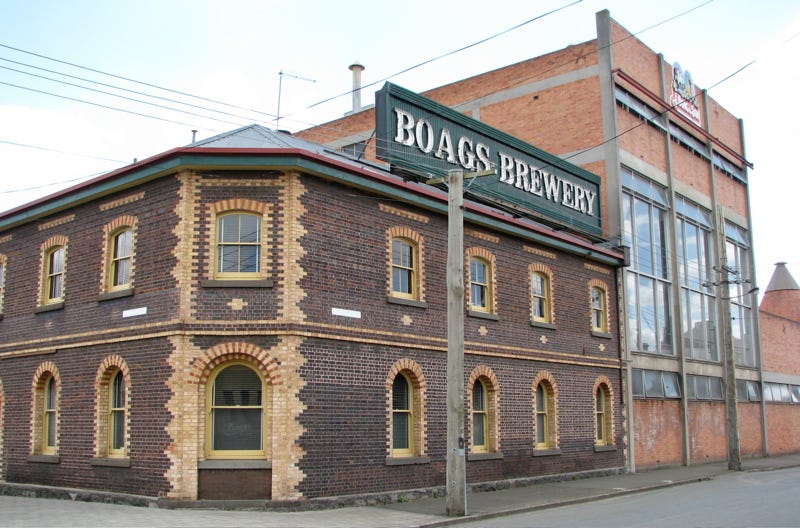
Last week, Kirin Holdings-subsidiary Lion announced its plan to close the historic Boag’s brewery in Launceston, Tasmania. 42 union brewery workers are slated to lose their jobs with the brand being shifted to production on the mainland and away from its home for the last 150 years. Workers and their community, however, can push back against the authority of corporations. For where capital withdraws, there is opportunity for organised workers to step up and fill the space.
This is not easy, and there is no guaranteed success. So let’s unpack what organising for ownership looks like in transitioning existing enterprises and workplaces over to worker ownership and management, and how it might work for a workplace such as Boag’s.
The hurdle of viability in a capitalist market
First we need to acknowledge the barrier of financial sustainability within the context of a capitalist market. In my opinion, transitioning existing workplaces in financial distress is the least likely strategy to build the LMF sector. After all, oftentimes there is a reason as why an enterprise or workplace is failing and even a change to a more democratic form of management will not be enough to wrench an enterprise from a dying niche.
There are cases, however, where the enterprise is viable but existing private owners want to sell their business. This leaves open, where the right ecosystem is in place, that such owners will want to sell the business to their workforce rather than having a large corporation gobble up their life’s work.
Where the former owner essentially vacates the field of play through closing the business or workplace is probably one of the more difficult situations from which to establish an LMF in the present social context. There is usually an underlying reason why a business is no longer profitable and the ability to change this requires access to a pool of investment capital to turn around the enterprise that workers in the present climate cannot easily access (despite the fact that the world is drowning in a sea of idle money).
Conversely, the body of work done in worker education, incubating new cooperatives, policy development and implementation combined with the active confrontational organising increases the probability of transitions succeeding through a change in social context and institutions. The opportunity, therefore, to transition an existing enterprise depends not just on taking advantage of a moment of crisis but in the patient educational and organising work done beforehand (I will return to this in the next post). It is this patient organising work conducted over years that means potentially high-profile workplace closures like Boag’s could be a watershed moment in worker expectations and confidence in the struggle to remake society.
While the prospects of any one enterprise being successfully transitioned across to worker ownership are relatively low, the large number of employers across the union movement means that the prospect of suitable transition targets should not be ruled out. There are at least two types of target businesses that come to mind, although this initial list should not be treated as exhaustive.
Riding that boomer retirement wave to worker ownership
First, privately-owned businesses where the existing owners do not want to sell their legacy to a corporation and their children are not interested in taking over the enterprise, are one such potential target. This is especially so if the owners are nearing retirement age and are looking to fund their retirement but would also want to think that they are doing their best to look after the workforce. In the United States, this wave of boomer generation retirements is referred to as the “Silver Tsunami”, and only 20% of small business owners retiring find a buyer for their operation.1
Providing a supportive structure and normalising transitions to worker ownership for small to medium enterprises provides a mechanism through which LMFs can expand without being inherently tied to the risk of starting a new business.
This model will require an ability to organise the boss and get their buy in for this model of operation. Once this is achieved, however, a benefit of this sort of transition work is that it can occur according to a planned phase-in of worker ownership where the members are gradually skilled up to take increasing responsibility for the enterprise as well as gradually buying up ownership without having to find the capital to purchase the entire operation in one hit.
Iconic and historic workplaces that imbue meaning into a community
The second type of target workplace are iconic factories owned by large corporations which are vulnerable to community backlashes against their brand. Generally, these will end up being factories which make consumer products that are familiar to many people’s everyday lives. Some examples of these sorts of workplaces in Australia other than Boag’s include the Vegemite factory in Port Melbourne, Golden Circle in Brisbane’s northern suburbs, the XXXX brewery in Milton and SPC in Shepparton. The iconic nature of the workplace also heightens the possibility of additional government support for the transition or can be used to advance the worker ownership policy agenda.
There is also a small-window of possibility that private corporations find it is in their interests to support an orderly transition of these factories in order to facilitate a change in business strategy that does not invite negative consumer sentiment. While this scenario cannot form a proactive component of a radical organising for ownership strategy, it remains a possibility and being open to it means an opportunity to build democratic ownership is not missed.
As an aside, there may be some scope for transitioning existing workplaces and operators in the NDIS sector given the pressures involved for community organisations and sole practitioners in the funding model and the competitive threat of larger corporations moving in. Some social actors may be looking for an exit strategy that is seen to be looking after their existing workforce.
While transitioning existing enterprises is organising for ownership strategy, when unionists think of cooperatives, to the extent that they do, they think of it as a potential solution for enterprises in distress. This is perhaps the most difficult way to build the LMF sector. For it to be a viable option requires at minimum, exceptional commitment in the face of uncertainty from a majority of the key staff in the given business, an advanced range of institutional support options (which do exist in some jurisdictions globally like Italy) or sustained collective actions such as community pickets (as but one example).
Of course, there are a range of somewhat simple policies that add up to a real improvement in the conditions of starting new LMFs or transitioning an existing business into an LMF. This task, however, properly belongs to the political organising strategy of a revamped and radicalised union movement. Regardless, a viable organising for ownership strategy is possible and it can be complementary to both solidarity bargaining and disaster organising.
The best time for Boag’s workers and the union to have prepared for this moment was years beforehand, the second-best time is the present.
Organising strategies without structures to support them remain stuck in the realm of imagination. The next post will go through what sort of structures are required within labour movements to turn the work of pushing back against managerial control a reality. Such structures and educational work could be built quickly in the face of a public fight where there is the will, and the lack of such structures are not an excuse to avoid necessary struggle.
This post is the fourth post of chapter seven which is the second chapter in part three of the overall project. Part Three is Solidarity Beyond Wage and takes a look at the possibilities of solidarity beyond wage labour within the capitalist system. Use the about page to locate where you are in this broader project.
The news of the Boag’s closure has struck me that the work that forms as The Solidarity Wedge occupies multiple points in time. It is designed to point to a future time where unionists have taken some of the learnings from my writings and applied it in their own way to a revamped labour movement.
It is also a dialogue with the past (and my record of failure as I state in the opening post from last year). Key concepts such as organising for ownership, solidarity bargaining, disaster organising and so on I have previously written up and offered to my fellow elected leaders in the United Workers’ Union. It has been rejected in favour of the main public facing strategies we see today.
The Boag’s news hits particularly hard because as a union we could have helped the workforce head off this current moment. We chose not to fight the earlier redundancies that reduced the shifts on site. We let this happen, and we could have avoided it.
Hopefully I have failed so that workers may win. Some time.
Another great entry in this project. There's so much potential in this strategy. A very important part of a transition to a socialist society. Important to keep in mind what you stressed here about the difficulties of doing this transition with a company already in distress, but with the right training, education and planning, this can really be a catalyst to social change as well as a way to empower an improve the lives of workers at the local level in a relatively immediate way.
Needed a new mantra for “worker collectives”
Let’s face it Reaganomics is nearly 50 and its brand of capitalism has failed - with wealth distribution hitting the real workers as new slaves.
Let’s use the anger at profiteering by billionaires who can’t produce, workers education and practicality to a new world order with rewards honest workers collectives