


Let me start with a disclaimer. I’m not here to argue against either the existence of the 80:20 rule (otherwise known as the Pareto principle) or even its very utility as an analytic tool. I feel the principle of managerial prerogative has extracted the wealth from its easy first 80% of productivity gains, and part of what we are experiencing as capitalist stagnation in the Global North is life in the 20% tail of diminished returns. Capitalists flap around spending ever greater amounts of money trying to secure value from ever more elusive productivity gains. In some ways, the US$1 trillion AI bubble highlights this dynamic.
What I would caution against though is using the 80:20 rule to restructure social organisations from universal services, trade unions, and cooperatives. Stafford Beer in the opening chapter of The Heart of Enterprise has an interesting account of the 80:20 rule.
A machine for eating itself
Beer writes of Dr Richard Beeching, a management expert and head of British Railways, applying the 80:20 rule in the 1960s. In short, Dr Beeching oversaw an early austerity drive that resulted in cutting hundreds of train stations and thousands of kilometres of track. This was done across a couple of tranches. The idea being to cut the “uneconomic” tail of railway infrastructure usage (that is the 20% usage as opposed to the 80%).
The logic from a costs perspective appears sound: only support the 20% of service delivery that has 80% of the patronage. One simply ceases servicing past the 80/20 pay off point.

What Beer identified is that once such rounds of cost cutting have occurred, a new 80:20 equilibrium emerges. This sets up a situation where further non-linear economic cuts can occur using the same logic. See Beer’s diagram (Figure 2) below for how this logic plays out.
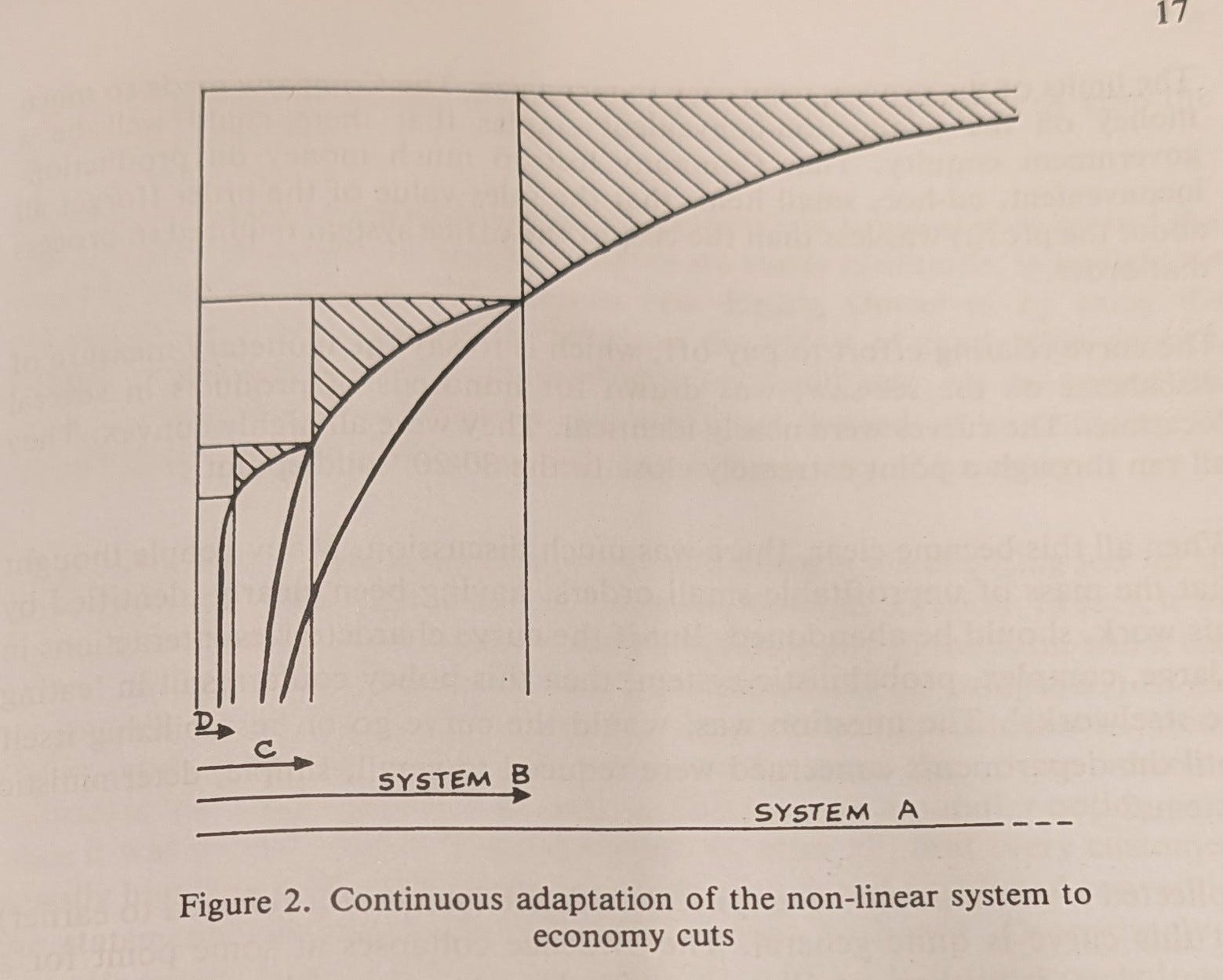
Used as a means through which to restructure an organisation, the 80:20 rule becomes a tool with which to eat the very organisation itself through time.
I have personally seen how this dynamic plays out. Well-meaning actors who imagine themselves to be Very Serious People™ adopt the 80:20 rule as a means through which to ensure the ongoing “sustainability” of an organisation. The end result, however, is an organisation that becomes smaller than it was before. In a union context this will mean supporting less union contracts, visiting less workplaces and contracting the number of organisers.
Unions and cooperatives end up with less members. Services shrink. The context differs but the result is a smaller, less ambitious organisation. Through time the horizon of transformation recedes.
Who does the 80:20 rule work for?
Joseph Juran, a management theorist, is credited with applying the Pareto principle to management theory from the 1940s. Although this was in the context of improving the quality of production by focusing on the vital few causes for most of the production issues. It is a short jump, however, from focusing on quality to costs. If it works in one context, then why not the other? The Pareto principle becomes a means with which to provide an intellectual veneer to austerity.
The 80:20 rule works, at least in the short-term, for the already wealthy. It is a means with which to cut back on state services, and to asset strip a business. If you’re a short-term shareholder or a private equity holder, applying the 80:20 rule to cut costs becomes a means through which to inflate profits even as underlying enterprise productivity flatlines. As a cost cutting rule it is a weapon of the corporate raider, and it has no business in guiding strategic and organisational planning within civil society.
The question arises as to why anyone would use it in a civil society context. Partly, viability issues are often expressed in budgetary or costs terms. The 80:20 rule then appears as a relatively objective means with which to secure the sustainability of the organisation - let us cut that which costs the most but delivers the least so we can at least continue to function as an organisation.
For member-driven organisations and universal services budgetary issues, however, are merely expressive of deeper viability threats. For trade unions, budgetary problems generally reflect deeper threats to the organising model from employer hostility to a lack of perceived utility on the part of workers. For services, a lack of funds is itself part of a deeper political contest around the value accorded to the work. A lack of funds is a real issue but it is not the issue. Applying the 80:20 rule becomes a means with which to cosplay as a serious and thoughtful leader without facing the structural reckoning.
The 80:20 rule applied to organisational costs becomes a means through which social organisations adopt the world view of the capitalist class, and in doing so does its work for it. Adopting the 80:20 rule is a means through social organisations eat themselves - weakening themselves and usually paying for the privilege of doing so.
What to do instead of applying the 80:20 rule?
When it comes to building effective organisations, Beer challenges us to see the system rather than just the dollars and cents. The 20% tail, for instance, could play an important role. Without looking at an organisation as a living system it is hard to gauge how cuts to the smaller branch lines and stations may impact patronage on the busier railway routes. For an animal a tail plays a pretty important role for overall balance and stability. So for organisations simply just cutting the uneconomic tail could just lead to heightened instability and crisis.
Examining an organisation as a living system, however, is not a straightforward exercise. This itself was the question that Beer spent thousands of pages over a matter of decades writing about. So hopefully this CyberOrg series can illuminate the 20% of Beer’s work that has an 80% pay off as far as building effective people goes…
This post is part of the Project CyberOrg series.
I am reengaged by this CyberOrg series, I still have plans to go back and pick up the main SW chapters, can't say when.